Tuesday, February 27, 2007

Double Double Toil and Trouble


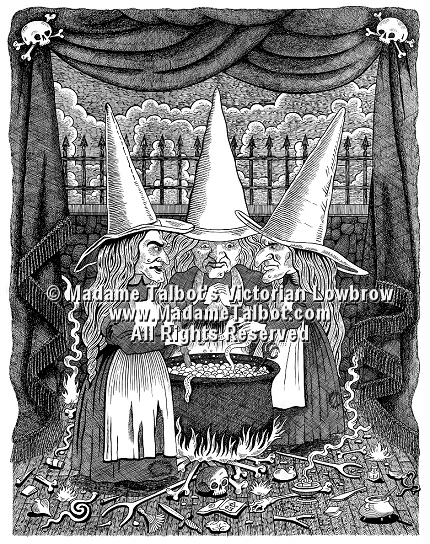
Next class we will be looking into the famous Double Double toil and trouble scene. Many of our ideas about witches having cauldrons come from this scene...

Act III, scenes 2-6

In this Act, we begin to see circumstances turn against Macbeth. The fourth scene of this Act is considered to be the turning point in the play.

In scene two, Macbeth reveals his plans to kill Banquo. He fears Banquo and he plans his murder without letting Lady M know any of the details. He tells her to "be innocent of the knowledge" so that she can simply applaud his work once it is completed. Lady Macbeth feels that they have lost everything and gained nothing. They are not happy with the outcome of their plans thus far, as they are in such a place of fear and nervousness because of the evil they committed. Lady Macbeth tells Macbeth though, that he must look happy for the guests at the banquet that evening. Macbeth agrees. The scene ends with him anticipating eveing so that the deed can be done. He says that there is more evil to come.

In scene three, three murderers attack Fleance and Banquo. Banquo is killed and dies telling his son to flee and have revenge for him. So, he will not see whether his son ever becomes King.

In scene four, their is a banquet with Macbeth and his lords. This scene shows his defeats; he discovers that Fleance has escaped and then each time he says Banquo's name, a ghost of Banquo appears. He is also seen as weakened and crazy in front of his guests. Lady Macbeth tells the lords that Macbeth has had fits since he was a child, so the lords should just ignore his behaviour. But, since he continues to see the ghost and begins to yell at it, the lords eventually leave the feast. Lady Macbeth tells him to get a grip on himself, as he is imagining the stuff of old wives tales, and there is no ghost there. Macbeth can't believe she can act so normal, and speaks of blood, saying he fears he also will be killed. He concludes the scene by deciding to go and see the witches again, to have answers to his questions.

Scene five is the Hecate scene, which may not have been written by Shakespeare. The queen of the witches is angry with the three sisters for not having included her in their meeting with Macbeth. She tells that that Macbeth is just using them for his own gain. They decide to go and see Macbeth the next day before noon, where they will fill him with a false sense of security and confidence in order to bring about his fall.

Scene six presents to us a Lord and Lennox, speaking sarcastically about all that has happened. They believe that Macbeth is responsible for the deaths of Banquo and Duncan, and that were Duncan's sons and Fleance here, they too would be dead. They speak of Macduff's plan to go and see Malcolm and to round up Northumberland and Siward to attack Macbeth and end his tyranical rein.
Thursday, February 22, 2007

Blog #3

Announcement: As I am still marking the second blog post, as well as some very late first posts, I have decided that this week's post will be due on Wednesday, rather than on Sunday as usual. This will also give us time to finish reading Act III. So, please have your third post in by Wednesday February 27th.

Here are your questions:

1)Discuss Macbeth's change in character in this act. You may wish to compare the behaviour of Lady Macbeth to Macbeth, especially in scene 4.

2) Discuss the defeats Macbeth suffers in this Act. What do other characters think of him now?

Act III, scene i

Here it is, in point form:

1) Banquo suspects that Macbeth was Duncan's murderer, and muses that perhaps the witches' prophecy will come true for him too.

2) Macbeth and Lady M tell Banquo that he will be their guest this evening. Macbeth complains that Malcolm and Donalbain are in England and Ireland spreading rumours. Macbeth asks Banquo to return for the banquet, and asks whether Fleance will be riding with him.

3) Macbeth then reveals his secret intent to have Banquo and his son Fleance murdered. He is angry that he has committed murder, sold his soul to the devil, in order for Banquo's descendents, not his own, to have the throne. He is also uneasy that Banquo may suspect him.

4) He hires two murderers to kill Banquo and Fleance on their way in, as he cannot do it himself without bringing disapproval on himself.

Sunday, February 18, 2007

Horses eating each other and chimneys...Act II, scene IV

In this scene, Ross and an old man discuss the strange events that have immediately followed Duncan's death. They say the weather has been strange, chimneys have blown over, Duncan's horses ate each other, and that symbolically, an owl killed a falcon. (Parallels Macbeth's murder of Duncan). Macduff appears and Ross questions him about the King's murder. Macduff says it is believed the grooms killed the king, acting for someone else. Since the king's sons have fled, everyone is suspicious that they may have done it. Macduff also reports that Macbeth is to be the new king and that Duncan's body had been taken to the burial place of his ancestors. Macduff says he will not attend Macbeth's coronation at Scone. He is worried that things will be worse off now that Macbeth will be king, and decides to return home to Fife.

Homework: be sure to finish your first assignment and begin your second one this week! Also, finish scene four questions.

Wednesday, February 14, 2007

Blog questions (#2)

Here are your questions for the second blog post, which is due by Sunday morning. As we have no school on Friday, you get an extra day to work on it, so should have it completed in time. The same rules apply: around 100 words or more, include citations in your argument, and reference to the text. Also, be sure to have a clear topic sentence, and a strong final sentence to conclude your paragraph. Finally, there were many typos in the first blog posts, so be sure to proof read. Please DO NOT include your name here--only your student number. Thank you,
Any questions can be directed to smcmeek@uvic.ca

Questions:

1) Do you think Lady Macbeth is beginning to break down? Are there any signs of weakness in Act II that would make you think this? (Hint: there are at least 3 examples that could be seen as signs of weakness).

2) Discuss the images of darkness in the play. Why was it appropriate that Duncan was murdered at night?

3) Discuss Banquo's character. What type of a person is he? Why would Shakespeare have protrayed him in this way? Use lines of Banquo's speeches to support your answer.

Act II, scene 3

This scene can be divided into four main parts:

1) The comic relief from the porter, who is drunk. Ironically, he pretends to be guarding the gate of hell.

2) The arrival at the castle, and the greeting by Macbeth of Macduff. Macduff tells of the strange lamentings and bizarre weather (chimneys blown down, etc.). Macbeth seems much more calm and sure of himself--he speaks in understatements. First, he says, when asked if the King is stirring "Not yet" and then he says in response to the strange occurences of the previous evening "Twas a rough night."

3) Then, we get the castle's reaction to the murder. Everyone is horrified--even Lady M puts on a good show, crying and fainting when Macbeth begins to go a little overboard in his exclamations and sorrow over the death of Duncan. At first, Macbeth's speech sounds sincere, but then he elaborates a little too much. He also admits to having killed the two chamberlains outside of Duncan's room, stating that when he saw the King, he needed to seek revenge on the person who did this to him. This was clearly due to the fact that Macbeth was worried that the chamberlains might tell everyone that he was the one who did it. However, just in the nick of time, Lady M faints and draws attention away from her husband.

4) Malcolm and Donalbain now take the stage to show us their reaction to the death. They fear for their lives, as they believe that the closer they are in blood relation to the King, the more likely they will also be murdered. They also say that it is easy to put on a false sorrow, and so choose not to consort with the rest of the characters. They flee to separate countries--Ireland and England, believing they will have a better chance if separated.